Window Comparison Marvin vs Andersen vs Pella
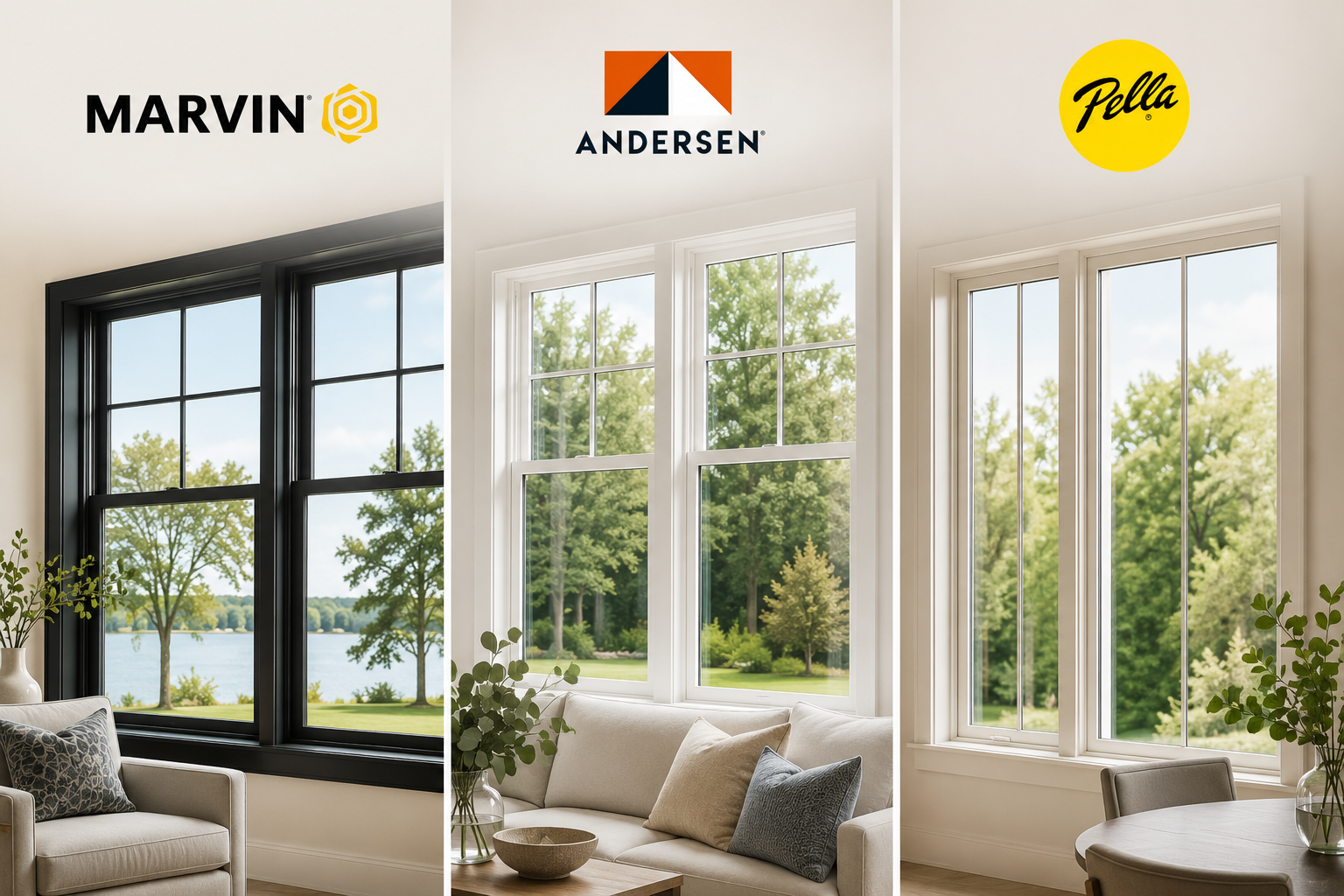
If you're planning a new build or a full window replacement, you've probably already noticed that "which windows should I buy" doesn't have a simple answer. Marvin, Pella, and Andersen each sell half a dozen different product lines, the marketing on every manufacturer's website reads almost identically, and every local dealer swears their brand is the best one. That makes it nearly impossible to compare apples to apples — which is exactly the problem this guide is meant to solve.
We build custom homes across South Bend, Notre Dame, Northern Indiana, and the lake communities of Southwest Michigan, and we install windows from all three of these manufacturers, matched to the homeowner's budget, design goals, and priorities. This is our honest, in-the-field comparison — energy performance, materials, warranty coverage translated into plain English, known issues, and the service experience homeowners actually get when something goes wrong. We'll give you the real specs and the real complaints on every line so you can make an informed call for your own project.
The Quick Answer
If you only read one section, read this one.
| Line | Manufacturer | Exterior Material | Typical U-Factor* | Tier | Best For |
|---|---|---|---|---|---|
| Signature (Ultimate) | Marvin | Extruded aluminum clad | ~0.15–0.32 | Premium | Custom homes, full design flexibility |
| Elevate | Marvin | Ultrex fiberglass | ~0.15–0.29 | Upper-mid | Best value-to-performance ratio |
| Vivid | Marvin | Ultrex fiberglass + fiberglass composite interior | No published NFRC figures yet | Upper-mid, contemporary | Modern, low-maintenance design — now available to us as a Marvin dealer |
| Reserve / Architect Series | Pella | Extruded aluminum clad | 0.21–0.23 (triple-pane) | Premium | Historically detailed or architect-driven designs |
| Lifestyle Series | Pella | Roll-formed aluminum clad | 0.25 and up | Mid | Budget-conscious clad-wood buyers |
| E-Series (Architectural Collection) | Andersen | Extruded aluminum clad | Varies by config. | Premium | Fully custom shapes, sizes, colors |
| A-Series | Andersen | Fibrex composite | 0.28–0.32 | Upper-mid | Andersen's best energy performance |
| 400 Series | Andersen | Fibrex/vinyl (Perma-Shield) | 0.26–0.33 | Mid | Most popular, widest stocking availability |
*For Marvin's Signature and Elevate collections, U-factor is driven primarily by the glass package you choose, not the frame material — see the note in Energy Performance below before assuming one collection outperforms the other. Vivid's U-factor isn't yet independently published; see the note in Materials below.
Use this table to get oriented, then keep reading for the details that actually matter once you're comparing real quotes: materials, warranty terms translated into plain English, known issues, cost, and installation.
Window Terms, Translated
A few terms come up constantly in window shopping and rarely get explained. Quick definitions before we go further:
U-factor: how much heat escapes through the window. Lower is better. Ranges from about 0.15 (excellent) to 0.35+ (basic).
SHGC (solar heat gain coefficient): how much of the sun's heat passes through the glass. Lower is better if you want to block summer heat; a bit higher can help with winter passive solar warmth.
Clad / cladding: the protective outer layer (usually aluminum, fiberglass, or vinyl-composite) bonded over a wood or composite frame to resist weather without needing to be painted.
Extruded vs. roll-formed aluminum: two different ways to manufacture aluminum cladding. Extruded is pushed through a shaped die and is thicker and more durable; roll-formed is bent sheet metal and is thinner and less expensive.
Seal failure: when the airtight seal between two panes of glass breaks down, letting argon gas escape and moisture in — shows up as permanent fog or haze trapped between the panes.
NFRC rating: the independent, third-party test rating (U-factor, SHGC, and more) that appears on the sticker on every new window; this is the number to trust over marketing claims.
PG rating (performance grade): a measure of structural strength — wind and pressure resistance — mostly relevant for large openings or high-wind/coastal exposures.
Wait — Which Andersen Line Are We Even Comparing?
This trips a lot of homeowners up, so it's worth a sidebar. Andersen doesn't sell a single "premium" line the way it might seem from a showroom visit. The three that matter for this comparison are:
400 Series — Andersen's most popular and widely available line. Wood interior with a Perma-Shield exterior made from Fibrex, Andersen's proprietary composite.
A-Series — the Architectural Collection's mid-tier product, still Fibrex-clad but with more configuration options and Andersen's best standard energy performance.
E-Series — the true premium line, and the one that actually competes head-to-head with Marvin Signature and Pella's Reserve/Architect Series. This is the only Andersen line with genuine extruded aluminum cladding, and it's built fully custom — any size, shape, or color.
Pella has gone through a similar rebrand. The line most people still call the "Architect Series" has been folded into what Pella now markets as the Reserve collection (Traditional and Contemporary). You'll see both names used in the market, sometimes on the same dealer's website, so don't assume they're two different products — for this comparison we're treating them as one.
Materials: What's Actually Behind the Marketing
Aluminum cladding isn't all the same thickness
This is the single most misunderstood spec in the entire window industry. "Aluminum-clad" can mean two very different manufacturing processes:
Extruded aluminum is heated and forced through a die, then painted after forming. It's thicker, holds paint finish better, and is rated for a 20-year finish warranty against chalking, fading, and loss of adhesion under AAMA 2605 standards. Marvin's Signature (Ultimate) cladding is extruded and finished to a minimum of 1.2 mils — up to three times thicker than typical roll-formed aluminum. Andersen's E-Series is also extruded.
Roll-formed aluminum is sheet metal bent into shape on rollers, then finished. It's less expensive to produce and generally thinner. Pella's Lifestyle Series uses roll-formed aluminum cladding; Pella's premium Reserve/Architect Series line moves up to extruded aluminum, matching Marvin Signature and Andersen E-Series on this spec.
If you're comparing Pella Lifestyle to Marvin Elevate specifically (a common matchup, since both sit in the mid-upper tier), note that Elevate isn't aluminum-clad at all — it uses Marvin's Ultrex pultruded fiberglass, which behaves differently than either aluminum option (more on that below).
Fiberglass: Ultrex vs. Fibrex
Marvin and Andersen both offer composite/fiberglass exteriors, but they're not the same material:
Ultrex (Marvin) is pultruded fiberglass — pulled through a die under tension rather than rolled or extruded. It expands and contracts at nearly the same rate as glass, which matters because it means the seal between sash and glass experiences less stress over decades of temperature swings. It carries an acrylic finish 3x thicker than typical painted competitive finishes and is rated to AAMA 624 standards for weathering and color retention.
Fibrex (Andersen) is a composite of roughly 40% reclaimed wood fiber and 60% thermoplastic polymer, patented in 1992. It's twice as strong as vinyl and is used across Andersen's 400 Series (exterior cladding) and A-Series.
Both are legitimate, low-maintenance materials with good track records. The distinction matters most if you're weighing long-term thermal cycling in a climate like ours, with wide seasonal swings — pure fiberglass (Ultrex) has a lower published coefficient of thermal expansion than a wood-fiber composite (Fibrex), which manufacturers cite as a factor in long-term seal durability. Both materials perform well when properly installed and maintained.
Wood interiors
All three manufacturers default to pine for interior wood species across their standard lines (Marvin Signature/Elevate, Pella Lifestyle/Reserve, Andersen 400/A/E-Series), with upgrades available to species like Douglas fir, mahogany, or white oak at additional cost, most commonly on the premium tiers (Marvin Signature, Pella Reserve, Andersen E-Series). Marvin's new Vivid line breaks from this pattern entirely — it uses a proprietary pultruded fiberglass-composite material on the interior instead of wood, aimed at buyers who want a fully low-maintenance window inside and out.
A note on the new Marvin Vivid line
Marvin's Vivid collection launched in March 2026 and is genuinely new — a fiberglass-composite interior paired with Ultrex fiberglass exterior, large-format sizing (heights up to 10 feet, performance grades up to PG50), and a design-forward aesthetic aimed at modern and contemporary builds. Marvin rolled it out first in Texas, Colorado, Kansas, Montana, Idaho, Washington, and Oregon, with additional markets following through 2026 — and as of this summer, it's reached us too. We're still early in specifying it on real jobs, so independent, real-world durability data specific to our climate is still limited.
On energy performance specifically: as of this writing, Marvin hasn't published standalone NFRC U-factor or SHGC figures for Vivid in its public technical library — its documentation covers construction details, installation, and hardware, but not a dedicated energy-performance sheet the way Ultimate and Elevate have. What we do know is that Vivid shares its Ultrex fiberglass exterior with Elevate and draws from Marvin's standard glass package options, so its performance is likely in a similar range once specified — but we'd rather tell you that data isn't published yet than guess at a number. Ask your dealer for the current NFRC label on the specific Vivid unit and glass package you're considering, and we'll update this guide once we have real project data of our own.
Energy Performance: The Real Numbers
Every manufacturer will hand you an ENERGY STAR sticker, but ENERGY STAR is a regional pass/fail threshold, not a performance ranking — a window can barely clear the bar for its climate zone and still carry the label. U-factor (lower is better; measures heat loss) and SHGC, or solar heat gain coefficient (lower is better for heat gain in sunny exposures, higher can be desirable for passive solar heating in cold climates) are the numbers that actually differentiate products.
Rough ranges by line, using standard double-pane or triple-pane packages with Low-E glass and argon fill:
Marvin Signature (Ultimate): U-factor roughly 0.15–0.32, SHGC 0.18–0.52 depending on glass package
Marvin Elevate: U-factor roughly 0.15–0.29 depending on glass upgrade
Marvin Vivid: no standalone NFRC figures published yet; likely comparable to Elevate given the shared Ultrex exterior and glass options, but ask your dealer for the current label on your specific unit
Pella Lifestyle Series: U-factor as low as 0.25, SHGC as low as 0.20
Pella Reserve/Architect Series (triple-pane): U-factor 0.21–0.23, SHGC 0.23–0.28
Andersen 400 Series: U-factor 0.26–0.33, SHGC 0.40–0.44
Andersen A-Series: U-factor 0.28–0.32, SHGC 0.15–0.24 with SmartSun glass
A note on reading these ranges correctly: U-factor is driven mainly by the glass package (single vs. double vs. triple pane, number and type of Low-E coatings, gas fill) rather than by which collection or frame material you choose. Marvin's Signature and Elevate collections both offer the same range of glass upgrades, up to a triple-pane, dual-Low-E package — so it's a mistake to assume the more expensive, more customizable Signature collection is automatically more energy efficient than Elevate, or vice versa. The frame material differences between them (extruded aluminum vs. Ultrex fiberglass) matter more for durability, maintenance, and design than for the U-factor number itself. Always ask for the NFRC-rated U-factor and SHGC of the specific glass package on your specific quote, for your specific collection, rather than assuming a premium tier automatically wins on energy performance.
Most of Northern Indiana and Southwest Michigan sits in IECC Climate Zone 5, which is why triple-pane glass comes up so often in these conversations. Here's what it actually is and does, so you can decide with your builder whether it's worth it for your project: triple-pane adds a third layer of glass and a second sealed air space between two Low-E coatings, which typically lowers the U-factor (less heat loss) and can raise the interior glass surface temperature in winter. All three manufacturers offer it as an upgrade on most of the lines in this comparison.
The tradeoffs are real: triple-pane windows generally cost more, are heavier (a real consideration for large openings, tall sashes, and hardware), and the improvement can be modest on units where the overall glass thickness is squeezed to fit a standard sash — a "triple-pane" window isn't automatically a big upgrade over a well-built double-pane unit. It's worth asking any dealer for the actual NFRC-rated U-factor and condensation resistance (CR) rating of the specific unit you're quoted, rather than assuming "triple-pane" alone tells the whole story. Whether it's the right call depends on your budget, your specific rooms and exposures, and how you plan to manage indoor humidity — not a blanket rule.
One related, often-overlooked point: a tighter, more energy-efficient home actually increases your risk of window condensation, not decreases it, because there's less natural air exchange to carry moisture out of the house. We go deep on that topic — including the exact indoor humidity levels you should target based on outdoor temperature — in our companion guide to window condensation and indoor humidity.
Warranty Coverage, Side by Side
Warranty length is where the marketing gets slippery, and the fine print rarely gets translated into what it actually means for you day to day. Here's the technical summary, followed by what each one actually means in practice.
Marvin (Signature and Elevate): 20 years on insulating glass seal failure, 10 years on non-glass components and hardware, and 5–10 years on exterior finish (chalk, fade, loss of adhesion) depending on the line. Fully transferable to a new owner.
Pella (Lifestyle and Reserve/Architect Series): Marketed as a "limited lifetime" warranty on wood windows — but "lifetime" only applies to the original purchaser, for as long as they own and live in the home.
Andersen (400, A-Series, E-Series): 20 years on glass, 10 years on non-glass components (locks, hinges, balances, weatherstripping, frame, sash), counted from your purchase date. Transferable through Andersen's Owner2Owner® program.
What this actually means for you
Marvin, in plain terms: if a glass unit fogs from a seal failure within 20 years, the replacement glass is covered. If a lock, hinge, or other hardware part fails within 10 years, that's covered too. Sell the house within that window and the coverage carries over to the new owner automatically. One detail worth knowing: Marvin's manufacturer warranty covers the product and materials, not installation labor — that's covered separately by whichever certified dealer installed your windows, which is one more reason the dealer you choose matters as much as the brand you choose.
Pella, in plain terms: as the original owner living in the home, most non-glass parts (frame, sash, hardware) are covered for as long as you own and occupy it — that's the "limited lifetime" piece. Glass coverage is shorter and varies by product, typically 5 to 20 years. Labor is only covered for the first 2 years; after that, Pella will still send you a replacement part under warranty, but you pay to have it installed. And if you sell the home, the warranty doesn't transfer at full strength — it converts to a flat 10 years counted from the original purchase date for the next owner, not a fresh 10-year clock starting at the sale.
Andersen, in plain terms: glass is covered for 20 years and hardware/frame components for 10, both counted from your purchase date rather than "for life." If you sell the home, Andersen's Owner2Owner program automatically carries the remaining coverage over to the new owner at no cost and no paperwork. Installation labor is covered separately, for 2 years, under a distinct installation warranty rather than the product warranty itself.
On paper, Pella's "lifetime" language sounds like the longest commitment of the three. In practice, all three warranties are worth reading in full before you buy, since the marketing summary and the actual written terms don't always tell the same story — which brings us to known issues and service.
Known Issues We've Seen and What's Been Reported (Last Few Years)
No manufacturer in this category is issue-free, and you should be skeptical of any comparison that pretends otherwise. Here's what's actually been documented recently, along with what we've observed on our own jobsites.
Marvin: The most common complaints in the last couple of years involve seal and weatherstripping fit at installation — homeowners and forums have reported visible daylight at seals on a portion of units in a given order, and some documented air infiltration in high-wind exposures, particularly on the Infinity fiberglass line (a separate direct-to-consumer Marvin brand, distinct from Signature/Elevate/Vivid). We've also seen occasional long turnaround times on replacement parts. Notably, the pattern in complaint data skews toward installation and fit-and-finish issues rather than structural or water-intrusion failures.
Pella: the most serious documented history of the three, though it's older and narrower than it's sometimes made to sound. Pella settled a nationwide class-action (Eubank v. Pella, originally filed in 2006) over allegations that water could get behind the aluminum cladding on its ProLine® brand casement, awning, and transom windows — including the 250 and 450 Series — causing wood rot. The settlement, finalized in 2018, covered windows manufactured between 1991 and 2009 and established a fund of roughly $25.75 million for repairs and claims.
Two things worth knowing here: this settlement is specific to ProLine-branded windows manufactured in that 18-year window, and it does not apply to windows Pella sells today, including the current Lifestyle Series or Reserve/Architect Series lines covered in this comparison. If you're ordering new Pella windows now, you're not buying into that litigation. More recent (2024–2025) complaints we found skew toward casement seal leaks and slow customer service response on warranty claims — a different pattern than the older wood-rot issue.
Andersen: Andersen has an older (roughly 2011-era) history of a class-action related to mold and wood rot from seal failures on 400 Series wood windows, which predates the current Fibrex-era product and has largely aged out of relevance. Complaints we see reported in 2024–2025 lean toward installation delays, backordered parts and trim pieces, and scheduling — less about the product itself failing.
The honest summary: Pella carries the most serious documented product-defect history of the three (the water-intrusion lawsuit). Andersen's recent complaint pattern is mostly about service logistics, not product failure. Marvin's issues cluster around installation fit and occasional part delays. None of this means "never buy X" — it means installation quality and dealer support matter as much as the window itself, which is the next section.
Why Proper Installation Matters as Much as the Window You Choose
We can't overstate this: a premium window installed poorly will underperform a mid-tier window installed correctly. The single most common cause of water intrusion around a window isn't a bad seal from the factory — it's missing or improperly sequenced flashing at the rough opening. Flashing directs water that gets behind siding or trim away from the wall cavity; without it, water finds the framing and rot begins, often silently, for years before it's visible.
Every manufacturer we've discussed here also requires installation per their published specifications to keep the warranty valid — if a claim comes in and the installation doesn't match spec, the manufacturer can (and often does) deny it, regardless of how the product itself performed. That's why we only install through certified installer programs.
A few questions worth asking any builder or dealer before you sign a contract, regardless of which brand you choose:
Are you certified by this specific manufacturer, and for this specific product line?
How many of these units have you personally installed?
If something needs warranty service in year 8, do you handle that directly, or does it go through a call center?
What's your own labor warranty, separate from the manufacturer's product warranty?
Service Experience: Where the Brands Really Separate
This is the part most comparison articles skip, and it's the part that matters most once you've lived in the house for five years.
BBB ratings are nearly useless for differentiating these three — Marvin, Pella, and Andersen all carry A+ BBB ratings. Aggregated consumer review platforms tell a more useful, if noisier, story: Pella and Andersen both show low average scores on sites like Trustpilot (roughly 1.5 out of 5), though these self-selected samples skew heavily toward people who had a bad experience and went looking for a place to vent — a limitation worth keeping in mind with any review aggregator. That said, industry complaint-volume data has shown Andersen receiving meaningfully fewer complaints than Pella over comparable periods, and Marvin's last widely cited J.D. Power window and patio door satisfaction study (2018) scored it well, particularly on appearance and design.
One structural difference worth knowing: Marvin is sold through a network of independent dealers rather than big-box retail channels, while Pella and Andersen both sell through their own dealer networks in addition to big-box retail (Pella through Lowe's, Andersen through Home Depot). In practice, this means a Marvin warranty claim typically routes through the single local dealer who sold and often installed the windows. A Pella or Andersen claim may route through more than one entity — the retailer, the manufacturer, and/or an installer — which some homeowners experience as more hand-offs and longer waits, while others find the larger retail network gives them more points of contact and less dependence on any single dealer's longevity. Which model you'll prefer depends on how you weigh those tradeoffs.
Cost: What You're Actually Paying For
We're intentionally not publishing hard dollar figures here, because window pricing swings enormously based on your dealer, your region, glass package, grille pattern, hardware finish, and current material costs — a number we quote today could be stale in six months. What we can tell you is how the lines stack up against each other in relative cost, high to low:
| Line | Manufacturer | Relative Cost |
|---|---|---|
| Signature (Ultimate) | Marvin |
$$$
|
| E-Series (Architectural Collection) | Andersen |
$$$
|
| Reserve / Architect Series | Pella |
$$$
|
| Vivid | Marvin |
$$–$$$
|
| Elevate | Marvin |
$$
|
| A-Series | Andersen |
$$
|
| 400 Series | Andersen |
$
|
| Lifestyle Series | Pella |
$
|
Get a project-specific quote before assuming any brand is "the expensive one" — in our experience, the gap between a well-specified Andersen 400 and a well-specified Marvin Elevate is often smaller than homeowners expect once glass packages and finishes are matched up.
Frequently Asked Questions
Which window brand is the best? There isn't a single "best" — it depends on your budget, your design goals, and how much you value dealer-driven service versus retail convenience. Marvin, Pella, and Andersen all make legitimate, widely-installed products; the differences that matter most are in the specific line, the glass package, and the installer.
Do these windows really come with a lifetime warranty? Only Pella markets a "limited lifetime" warranty, and it applies only to the original owner for as long as they own and live in the home — it converts to a flat 10 years for a new owner if the home sells. Marvin and Andersen both use specific, non-"lifetime" terms (typically 20 years on glass, 10 years on hardware) that are more conservative but arguably easier to understand.
What's the difference between Pella's Lifestyle Series and Architect/Reserve Series? Mainly the cladding and design flexibility: Lifestyle uses roll-formed aluminum cladding and simpler configurations, while Reserve/Architect Series (Pella's current name for what many still call the Architect Series) uses extruded aluminum and offers more custom shapes, sizes, and historically accurate detailing.
Choosing Between Them
There's no single "best" brand among these three — only the best fit for a given project, budget, and set of priorities. A few honest starting points:
If budget is the priority: Andersen 400 Series and Pella Lifestyle Series are proven, widely available, and sit at the more accessible end of this comparison.
If you're building custom and want maximum design flexibility: Marvin Signature, Pella Reserve/Architect Series, and Andersen E-Series are all comparable premium, fully custom, extruded-aluminum-clad options.
If a low-maintenance, non-wood exterior matters most: Marvin Elevate and Vivid, and Andersen's Fibrex-clad lines, are worth a close look.
If warranty simplicity matters to you: compare the plain-English breakdowns above rather than the marketing headline — "limited lifetime," "20 years," and "Owner2Owner" all mean different things in practice.
We install and stand behind all three of these brands, and we'll help you weigh these tradeoffs against your specific site, budget, and design goals rather than steering you toward one brand by default.
Let's Talk About Your Windows
If you're planning a custom home or a full window replacement in our area, we'd rather walk you through actual samples — Marvin, Pella, and Andersen side by side — than have you make this decision off a spec sheet alone. We'll also help you think through glass packages and humidity control for your specific site, since the "best" window on paper can still sweat and underperform in the wrong home if indoor humidity isn't managed. (More on that in our guide to understanding window condensation.)