
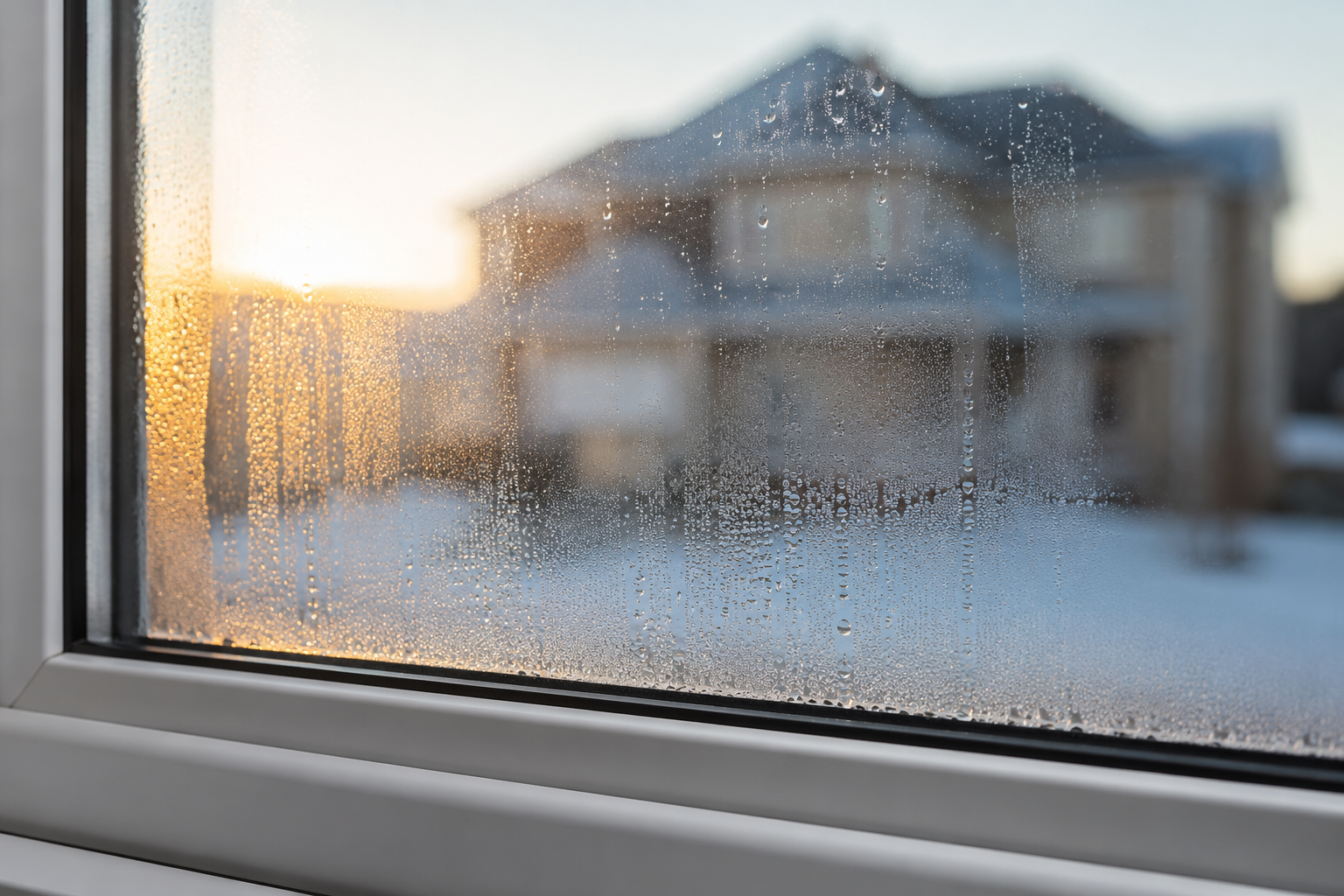
Why is there condensation on my windows?
Every fall and winter, we get some version of the same call: "There's water pooling on my windowsills every morning — did I get bad windows?" It's one of the most common questions homeowners ask us, and it's also one of the most misunderstood. In almost every case, the window isn't the problem. Your indoor humidity is.
This guide walks through why condensation actually forms, how to tell normal condensation from a sign that something is genuinely wrong, what humidity level you should be targeting in your home, and how to get there. If you're in the middle of researching new windows for a build or replacement project, this pairs directly with our comparison of Marvin, Pella, and Andersen windows — because even the best window on the market will sweat if the humidity inside your home is out of balance.
The Simple Science Behind Condensation
Condensation forms whenever warm, moisture-laden air meets a surface cold enough to cool it below its dew point. Air holds a certain amount of water vapor depending on its temperature — warm air holds more, cold air holds far less. When warm indoor air touches a cold window surface, the air right at the glass cools rapidly, can no longer hold onto its moisture, and that moisture drops out as liquid water on the glass.
This is exactly why condensation shows up almost exclusively in winter: your windows are the coldest surface in the house, chilled by outdoor temperatures on the other side of the glass, while your indoor air stays warm and, often, more humid than you realize from cooking, showering, and simply living in the space.
The reason condensation forms is that indoor humidity is too high for how cold the glass is getting — not because there's something wrong with the window. That said, there absolutely are situations where the window itself is the issue, and it's important to know the difference.
Normal Condensation vs. a Real Problem
Not all window condensation means the same thing. Here's how to tell them apart.
Condensation on the inside surface of the glass (normal, and fixable by you): If you can touch it, wipe it away, and it comes back the next cold morning, this is a humidity issue, not a product defect. It typically shows up worst at the bottom of the glass and around the frame edges, since those areas run coldest. This is the version we get calls about most often, and it's addressed by managing your indoor humidity, which we cover below.
Condensation on the outside surface of the glass (normal, not a concern): This usually appears on cool mornings, especially in spring and fall, when the glass surface temperature drops below the outdoor dew point overnight. It typically clears on its own once the sun warms the glass. Higher-performing, better-insulated windows can actually show more exterior condensation, not less, because the glass surface stays colder (closer to outdoor temperature) rather than losing heat from inside the house.
Condensation between the panes of glass (not normal — this is seal failure): If the fog, streaking, or haze is trapped between two layers of glass and doesn't wipe away no matter what you do, the insulated glass unit's seal has failed. The inert gas fill (usually argon) has leaked out and been replaced by humid air, which condenses inside a space you can't access to clean. This doesn't fix itself and doesn't respond to humidity control — it requires a glass unit replacement, and it's exactly the kind of failure a strong glass-seal warranty (commonly 20 years across major manufacturers) is designed to cover.
If you're seeing the third type, that's the moment to call your builder or a window professional and check your warranty coverage — it's unrelated to everything else in this guide.
Where All That Indoor Humidity Actually Comes From
Most homeowners are surprised by how much moisture a household generates every day without any obvious source. Common contributors include:
Cooking without running the range hood, showering and bathing without running (or long enough running) the bathroom exhaust fan, drying clothes on an indoor rack instead of venting a dryer outside, houseplants and aquariums, simply breathing (a household of four can add several pints of water vapor to the air per day), and — often overlooked — a newly poured concrete slab or freshly finished drywall and paint, which can release significant moisture into the air for months after construction.
Newer, tightly sealed, energy-efficient homes make this worse in one specific way: older, leakier homes constantly exchanged indoor air for (usually drier) outdoor air through gaps in the envelope, which kept indoor humidity lower without anyone doing anything on purpose. A well-built, properly insulated modern home holds onto that moisture instead, because it's not supposed to leak air uncontrolled. That's a good thing for your energy bills and comfort — but it means humidity has to be managed on purpose, with mechanical ventilation and ongoing monitoring, rather than by accident through a drafty building envelope.
Why a Brand-New, High-Performance Home Can Sweat More Than Your Old One
This is the single biggest source of confusion we hear from clients moving into a new custom home, so it deserves its own section: if you just moved from an older, drafty house into a new, tightly built one and you're suddenly seeing condensation you never saw before, that doesn't mean something went wrong. It's often the expected result of building a better house.
There's also a construction-specific factor that catches new-home owners off guard: a brand-new house is, quite literally, still wet. A poured concrete slab or basement floor can take a month or more per inch of thickness to fully cure and release its moisture into the air. Drywall mud, paint, and even the framing lumber itself carry moisture that gases off over the first one to two heating seasons. It's common for a new home's indoor humidity to run noticeably higher that first winter than it will in year three or four, purely because the building materials are still drying out. If you're in year one in a new build and dealing with more condensation than you expected, know that it typically improves as the house finishes curing — though it's still worth actively managing in the meantime using everything below.
A note for our region specifically: homes in South Bend, Northern Indiana, and along the Southwest Michigan lakeshore deal with an added variable — lake-effect humidity off Lake Michigan, which can push outdoor moisture levels higher than inland areas at the same temperature, especially in late fall and early winter. Combined with our IECC Climate Zone 5 winters (routinely well below freezing for weeks at a time), that's exactly the combination — cold glass, elevated ambient humidity — that makes disciplined humidity control worth the effort here more than in milder climates.
What Indoor Humidity Level Should You Actually Target?
This is the part most articles skip, and it's the most actionable piece of information in this guide: the ideal indoor humidity level isn't a fixed number. It depends on how cold it is outside, because that determines how cold your window glass gets.
A widely used guideline, based on standard HVAC humidistat charts, looks roughly like this for homes with standard double-pane windows:
| Outdoor Temperature | Recommended Indoor Relative Humidity |
|---|---|
| 20°F and above | 35–45% |
| 10°F to 20°F | 30–35% |
| 0°F to 10°F | 25–30% |
| -10°F to 0°F | 20–25% |
| -20°F to -10°F | 15–20% |
For general year-round comfort, health, and mold prevention (not specifically tied to window condensation), ASHRAE and the EPA both point to a broader 30–50% relative humidity range, with 40–50% typically recommended in summer and 30–40% in winter.
A few important caveats: these are general guidelines, not a guarantee — the exact threshold where your specific windows start to sweat depends on your glass package, how well-insulated your home is overall, and even whether you close blinds or curtains at night (which can drop the glass surface temperature further and trigger condensation earlier). Homes with triple-pane or higher-performance Low-E glass can typically tolerate a few points higher indoor humidity before condensation starts, since the interior glass surface stays warmer. If you're building new or replacing windows and know you want to run higher indoor humidity in winter for comfort, that's a good conversation to have with your builder before you finalize your glass package — it's much easier to plan for than to retrofit.
How to Actually Control Indoor Humidity
Once you know your target, here's how to get there and stay there:
Run your exhaust fans, and run them longer than feels necessary. A bathroom fan needs to run well after you finish showering — 20 minutes afterward is a reasonable rule of thumb — to actually clear the humidity a shower generates, not just the visible steam. Always run your range hood when cooking, especially when boiling water or using multiple burners.
Vent your clothes dryer outside, and skip indoor drying racks in winter if condensation is already a problem. Air-drying clothes is efficient and easy on fabric, but it puts a surprising amount of water vapor into the air of a tight home.
Install a hygrometer and actually check it. These are inexpensive and give you real data instead of guesswork about whether your home is running high.
Use mechanical ventilation appropriate to your home's construction. In a tightly built, energy-efficient home, a heat recovery ventilator (HRV) or energy recovery ventilator (ERV) provides continuous, controlled fresh air exchange — HRVs transfer heat only and tend to perform best in colder, drier climates, while ERVs also moderate (though don't remove) humidity and can perform better in more humid regions. Neither is a substitute for a dehumidifier if your home is running consistently high; think of them as ventilation, not dehumidification.
Add a whole-home or standalone dehumidifier if humidity stays elevated despite good ventilation habits. This is common in newer, well-sealed, high-performance homes, where there's simply less natural air leakage to carry moisture out on its own. A humidistat tied to your HVAC system can automate this, and higher-end models can even adjust the target humidity based on outdoor temperature automatically, rather than requiring you to manually dial it back every time a cold snap rolls through.
Address the source before you address the symptom. No amount of ventilation will keep up with an unvented gas appliance, a chronically running humidifier set too high, or a slab that's still curing. Rule out obvious sources first.
Tools That Make This Easier to Manage
You don't need to guess at any of this. A basic digital hygrometer (often under $20) tells you your current indoor humidity at a glance, and placing one near a window that tends to sweat gives you the clearest picture. If your home has a whole-house humidifier or dehumidifier, a wall-mounted humidistat lets you set and hold a target percentage automatically rather than adjusting it by feel; some models include an outdoor temperature sensor and will lower your indoor target on their own as it gets colder outside, which takes the guesswork out of the chart above entirely. Smart thermostats with built-in humidity sensors can also give you a rough read, though a dedicated hygrometer near the window itself is more accurate for this specific purpose than a single reading from a central thermostat.
When to Call a Professional
Reach out to your builder or a window specialist if you notice: condensation trapped between panes of glass (seal failure, not a humidity issue), visible mold or a musty smell developing around window frames or sills, wood trim that feels soft, discolored, or is visibly warping, or condensation that's severe enough to be running down walls or pooling on the floor, which points to a whole-house humidity problem rather than a window-specific one.
Persistent, unaddressed condensation — even the "normal" kind — can eventually damage wood sills, trim, and drywall if it's left unmanaged for years, so it's worth taking seriously even when it isn't a product defect.
Frequently Asked Questions
Is it normal for windows to have condensation in the winter?
Yes — condensation on the interior glass surface is common and usually just means indoor humidity is a bit high relative to how cold the glass is. It becomes a concern only if it's excessive, running down walls, or damaging trim and sills, or if it's trapped between panes of glass (a sign of seal failure).
What humidity should I keep my house at in winter?
As a general guideline, 30–40% relative humidity works for most homes in cold climates, but the safe number drops as outdoor temperatures fall — closer to 20–25% during extended stretches below 0°F, and even lower during severe cold snaps. See the chart above for a fuller breakdown by outdoor temperature.
Why does my new house have more window condensation than my old one?
New, well-built, energy-efficient homes hold onto humidity that older, leakier homes used to lose through uncontrolled air leaks. New construction materials (concrete, drywall, framing lumber) also release moisture as they cure over the first year or two. Both effects are normal and typically ease with time and active humidity management.
Can condensation damage my windows?
Surface condensation on the glass itself won't damage the glass, but persistent, unmanaged moisture can damage wood sills, frames, and trim over time, and can contribute to mold growth. Condensation trapped between panes indicates the seal has already failed and won't resolve without replacing the glass unit.
Will a dehumidifier fix window condensation?
In most cases, yes — if your indoor humidity is running above the recommended level for the current outdoor temperature, bringing it down with a dehumidifier (in addition to running exhaust fans and proper ventilation) is usually the most effective fix.
The Window Still Matters
None of this is an argument that window quality doesn't matter — it very much does. Higher-performing glass packages keep the interior glass surface warmer, which raises the humidity threshold before condensation starts, and a properly sealed, correctly installed window won't develop the seal failures that cause the "between the panes" version of this problem in the first place. If you're in the process of choosing windows for a new build or replacement project, we walk through exactly how Marvin, Pella, and Andersen compare on energy performance, materials, and long-term reliability in our full window comparison guide.
Schedule Your Complimentary Consultation →
Sources referenced in this article: Marvin: The Truth About Window Condensation, Andersen: Condensation on Windows, Pella: How to Deal with Window Condensation, GreenBuildingAdvisor: Indoor Relative Humidity and Window Condensation, Cardinal Glass Industries: Indoor Condensation.
